

Thresher shark monitoring
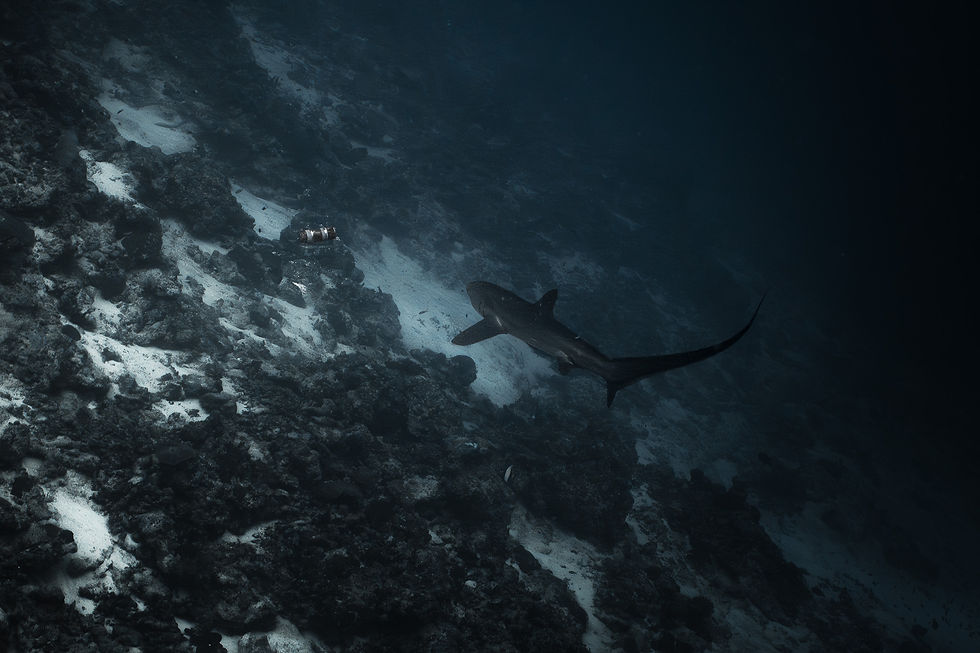
Fuvahmulah is one of the most important refuges for pelagic thresher sharks (Alopias pelagicus) in the Indian Ocean. These elusive, deep-diving sharks are rarely observed anywhere else with such consistency, making the island a globally significant site for long-term monitoring, conservation, and research. Despite their charismatic appearance and ecological importance, thresher sharks remain one of the least understood shark species due to their solitary nature, deep habitat range, and sensitivity to disturbance. Understanding their behaviour, movements, and presence around Fuvahmulah is essential to safeguarding the species and maintaining the ecological integrity of the island’s marine environment.
To address these knowledge gaps, we use Eye on the Reef (EotR) camera systems. These stations allow for continuous, non-invasive documentation of thresher presence and behaviour across key sites without the need for divers in the water.

occurrence & Seasonality
When do thresher sharks appear around Fuvahmulah?
Are there seasonal peaks in presence linked to oceanographic conditions?
Cleaning interactions
How do thresher sharks get cleaned?
How long are these interactions?
What body parts get cleaned the most?
Habitat use
Which locations around the island are most frequently visited?
How do environmental factors shape their local distribution?
Demographics
What life stages and gender use the site (juveniles, adults, pregnant females)?
Behavioural patterns
Do we observe cleaning behaviour, foraging cues, or social interactions?
Human impact
Are threshers showing signs of habituation or avoidance?
By combining non-invasive video monitoring, site-based ecological observations, and long-term data collection, this project generates the first consistent baseline dataset for thresher sharks in Fuvahmulah. These insights directly support local conservation decision-making, guide responsible ecotourism practices, and contribute to the global effort to protect a Vulnerable shark species whose biology is still poorly understood.
We work closely together with the Fuvahmulah Thresher Project, a multi-year project investigating the habitat use and demographics of pelagic threshers.

In collaboration with:
